About coffee
If we ask ourselves, "What is coffee?", then we must board a time machine that transports us to the origins of humanity in order to vaguely explore the clues to answering this question.
But what is it that allows such an ancient fruit to remain so modern and motivates us to make it accessible to you in such a refined way? Wild-grown and untreated in its origin, regeneratively and multi-stage roasted, and lovingly refined in our family-run business. That's our Next LEWEL® Coffee, but let's get to the heart of coffee itself!
Why is coffee a universal drink? Why do we love it?
Why is coffee, in all its diverse extraction methods, so popular?
Why is coffee called the equivalent of gold?
Let's begin with its discovery, its history and origin, before we turn to its timeless benefit for us, our performance and our palate!
At Next Life Up GmbH and our brand LEWEL UP®, we work with Giuseppe Lombardo and his family business in Sicily, where we source the coffee we obtain directly from small organic farms in Karnataka, India, where Robusta and Arabica beans naturally grow together. Giuseppe has been a professional coffee roaster for over 20 years. Throughout his journey with coffee, he has come to know and love coffee from the origin of the plant to the aromatic extraction in your cup.
Legends about the coffee plant tell of its discovery by a pastor in present-day Yemen, who felt euphoric and full of energy in a way never before known, after consuming this previously unknown colorful red coffee fruit.
The pastor wanted to bring this precious fruit to his rulers, preserve it for the journey, and continue to access its potent essence. This is how he apparently came up with the idea of roasting it. The monarchs thus enjoyed the drink, after which they too felt more alert, focused, and full of energy—a blessing, therefore, enabling them to better fulfill their duties. From then on, the Yemenis called this drink "quhwa" (which means "stimulating drink" in Arabic).
But how did coffee get to Europe?
The traces of medieval tales lead us from the pastor to Venice, where the importation of coffee into Europe is documented, and the first café of that era is mentioned in 1720 on the legendary Piazza San Marco. London, Amsterdam, Hamburg, and Berlin followed as coffee-importing cities. The green, brown gold became famous throughout Europe. The coffee plant and its diversity received increasing attention.
1.) Arabica: specified as optimal coffee with low caffeine content and a fruity, bitter note.
Grown and shipped from Central America, Asia and small areas of Africa.
2.) Robusta: specified as a connoisseur coffee with high caffeine content and a nutty, bitter note.
Grown and shipped from India, Africa and Asia (Vietnam, etc.)
3.) Liberica: born to compete with and replace Arabica in taste and characteristics, with rare success. Grown mainly in Liberia.
Physically and aromatically, Arabica and Robusta beans differ. Arabica beans are somewhat finer and more delicate in appearance and aroma, as well as caffeine content, while Robusta beans are more robust, less fruity, but nuttier and richer in caffeine than their sister. Their harmonious interplay is found in the typical Italian blend, known worldwide as the best coffee.
Is there such a thing as the perfect coffee?


Our bestsellers
-
Cocoa nibs (250g) in Demeter raw food quality
Regular price €12,90Regular price -
NEFROMAX herbal elixir for a healthy urinary system
Regular price €39,90Regular price -
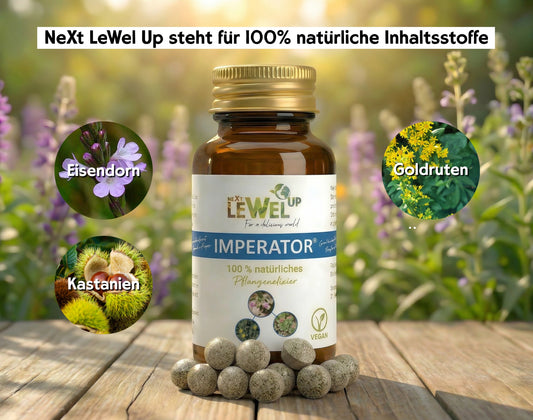
Heilpflanzen-Extrakt IMPERATOR® für die männliche Vitalität, ausgeglichenen Testosteron-Spiegel & gesunde Prostata
Regular price €49,90Regular price€0,00Sale price €49,90 -
INVERUM herbal elixir to support cognitive abilities
Regular price €39,90Regular price€39,90Sale price €39,90